
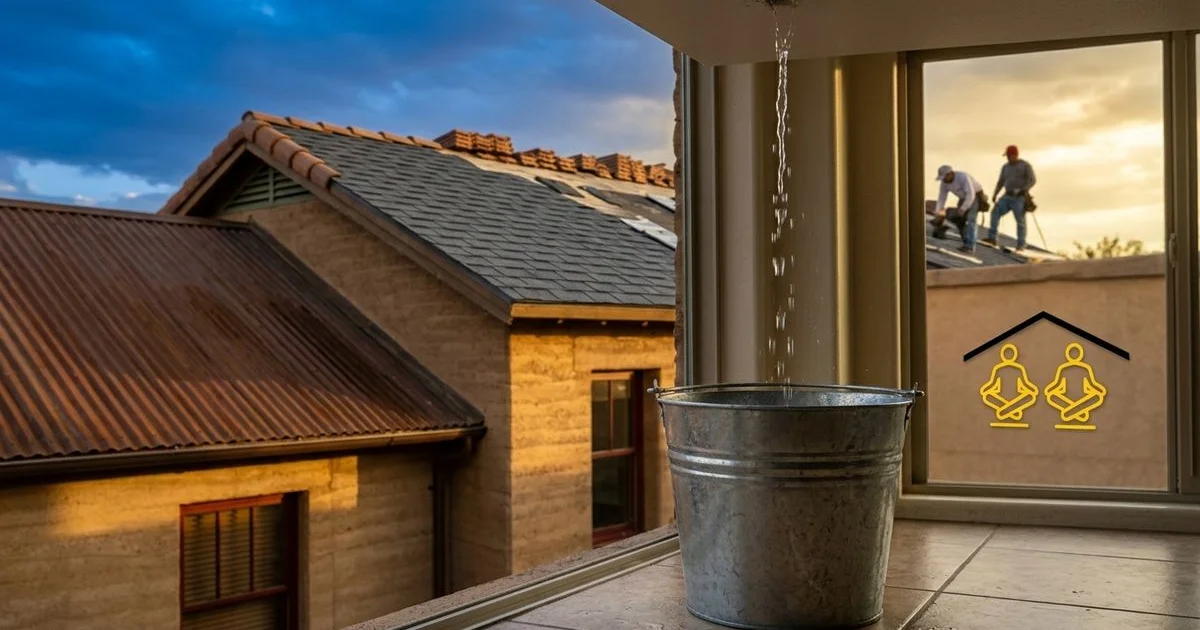
We know that sinking feeling when you hear a drip during a heavy monsoon downpour.
A dark stain spreading across the ceiling is a home emergency that demands immediate action right now. Facing a sudden roof leak? What to do before the roofer arrives dictates exactly how much secondary damage your property will sustain.
Our team at Tucson Roof Gurus, led by Kevin Bayes, has responded to hundreds of these emergency calls over the last 25 years.
The first hour makes all the difference.
Let’s review the specific steps you need to take immediately to protect your home and your wallet.
Step 1: Contain the Water
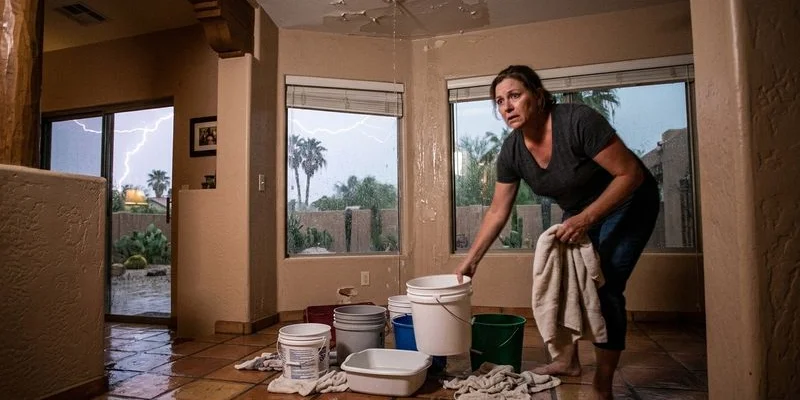
Your first priority is stopping that water from spreading across your floors and ruining your baseboards. We always tell Tucson homeowners to grab every bucket, trash can, and large pot they can find. Water weighs roughly 8.34 pounds per gallon, and a pooling ceiling can quickly accumulate dangerous weight that threatens your drywall. Place containers directly beneath every active drip immediately.
Our crews frequently see monsoon leaks start as a slow drip and escalate to a steady stream within minutes. You must be prepared to swap out containers as they fill.
Here is a quick checklist for immediate containment:
- Place large 5-gallon buckets under the heaviest drips.
- Line baseboards with thick towels to catch water running down walls.
- Keep a backup set of dry towels in the same room for quick swaps.
If you see a noticeable bulge forming in the ceiling drywall, you need to relieve that pressure before the entire section collapses. We recommend placing a large plastic trash can directly underneath the sagging area. Carefully poke a small hole in the center of the bulge with an awl or a screwdriver. This controlled release drains the trapped water and prevents a massive ceiling collapse that could dump dozens of gallons into your living space.
Step 2: Move Valuables and Electronics
Once you successfully contain the water, your focus must shift to protecting your personal property. We see preventable water damage ruin thousands of dollars worth of belongings every single summer. FEMA estimates that just one inch of flood or leak water can cause up to $25,000 in home damage, and ruined electronics accelerate those replacement costs rapidly. Move your laptops, televisions, and important documents away from the affected zone right away.
Our technicians highly suggest unplugging any devices in the wet room and relocating them to a completely dry location. Water near electrical outlets or overhead light fixtures is an extremely dangerous fire and shock hazard. Turn off the power to that specific circuit at your breaker panel immediately.
In Tucson homes equipped with evaporative coolers, check the roof water supply lines before assuming the roof deck has failed. We often respond to emergency calls where a broken 1/4-inch cooler line is mistaken for a failing roof system. If the water is dripping directly beneath your roof-mounted cooler, shut off the cooler water valve to see if the dripping stops.
Items to secure immediately:
- Computers and home office equipment
- Area rugs and easily movable furniture
- Family photos and vital paper documents
- Audio equipment and gaming consoles
Step 3: Document Everything
Before you clean up a single drop of water, pull out your smartphone. We urge every client to document the damage thoroughly for their insurance provider. Insurance adjusters rely heavily on photographic evidence to process your claim quickly and approve the necessary payouts. Take clear photos and videos of the ceiling stain, the active drip, and any damaged belongings in the room.
Our favorite tip is to use a free home inventory app like Encircle to organize these photos with accurate digital timestamps. Capturing wide shots of the room and close-ups of the specific damage gives your assigned adjuster a complete picture of the event.
| What to Photograph | Why It Matters for Your Claim |
|---|---|
| Active water dripping | Proves the sudden and accidental nature of the leak. |
| Damaged personal items | Creates a clear record for personal property reimbursement. |
| Floor and wall puddles | Shows the total spread and volume of the water intrusion. |
| The source on the roof | Helps the adjuster authorize the correct repair scope. |
Keep a written log detailing the exact time you first noticed the issue and what specific steps you took to stop it. We know that property insurance companies require policyholders to take reasonable steps to prevent further loss. Your organized photos and detailed written notes prove that you acted responsibly to mitigate the damage.
Step 4: Apply Temporary Fixes If Safe
If the heavy storm has completely passed and outside conditions are safe, you might consider a temporary patch. We strictly advise against climbing onto your roof while it is still raining, wet, or producing lightning. A slip on wet shingles is incredibly dangerous, and no temporary fix is worth a trip to the hospital.
Patching From Inside the Attic
If you can safely navigate your attic space without stepping off the joists, you might be able to slow the intrusion from the inside. We suggest using a piece of scrap plywood and heavy plastic sheeting as a temporary interior barrier. Press the patch firmly against the underside of the wet roof deck and secure it tightly with wood screws. Applying a thick layer of Henry 208R Rubberized Wet Patch can also seal small gaps even in damp conditions. Our goal here is just to stop the bleeding until our professional team can complete a proper repair.
Securing a Tarp Outside
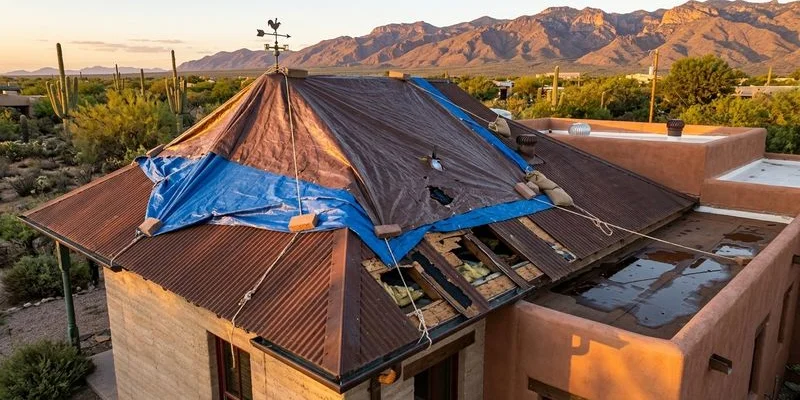
If the roof is fully dry and safely accessible, a tarp offers excellent temporary coverage. We recommend using a heavy-duty polyethylene tarp that is at least 10 to 12 mils thick to withstand Arizona winds. Secure the tarp firmly using screws driven through wooden furring strips to prevent the wind from lifting the edges. Never use loose rocks or bricks to hold down a tarp, as high monsoon winds can turn these heavy objects into dangerous projectiles.
Step 5: Call a Licensed Roofing Professional
With the water contained and your personal belongings safe, it is time to bring in the experts. We experience a massive surge in storm damage emergency calls during the peak of the Tucson monsoon season in July and August. Calling Tucson Roof Gurus at (520) 775-0388 as soon as possible secures your priority spot on our daily dispatch schedule.
When you call our local office, prepare to answer a few quick diagnostic questions. We ask these specific details to ensure our crews bring the exact materials needed for your specific property type on the very first visit.
Have the following details ready:
- Exactly which rooms are experiencing the water intrusion?
- How rapidly is the water coming through the ceiling?
- Do you have an asphalt shingle roofing, concrete tile, or flat roof system?
- Is the leak actively dripping right now?
Always verify that your chosen contractor is legitimate, licensed, and local. We strongly warn homeowners to watch out for out-of-town storm chasers who knock on doors after a major weather event. You can quickly check a contractor’s active license status on the official Arizona Registrar of Contractors (ROC) website. Verify that they carry active liability insurance and maintain a permanent physical office in southern Arizona.
What Not to Do
Making the wrong move during a water emergency can easily double your final repair bills. We have seen tiny, ignored drips rot out entire sections of wooden roof decking over a single monsoon season. Water always finds the path of least resistance, expanding that hidden path every time it rains.
Avoid these costly mistakes at all costs:
- Ignoring minor moisture: The EPA notes that toxic mold can begin growing on damp drywall within 24 to 48 hours of exposure.
- Attempting structural fixes yourself: Leave heavy lifting and complex shingle replacement to insured professionals with the right safety gear.
- Delaying your insurance call: Call your provider the exact same day to start the claim process before local adjusters get completely booked up.
Dealing with ceiling water damage is incredibly stressful for any property owner. We know that acting fast keeps the overall damage and repair costs to an absolute minimum. By following this clear, step-by-step process, you put yourself in the best possible position for a fast and smooth restoration. Tucson Roof Gurus stands ready to help you recover before, during, and after the storm passes.
Call (520) 775-0388 for emergency roof repair today, and get your home secured immediately.
Related Service
Learn more about our professional services related to this topic.
View Our Repair Service →
Kevin Bayes
Owner & Licensed Roofing Contractor
Owner of Tucson Roof Gurus with 25+ years of desert roofing expertise.