
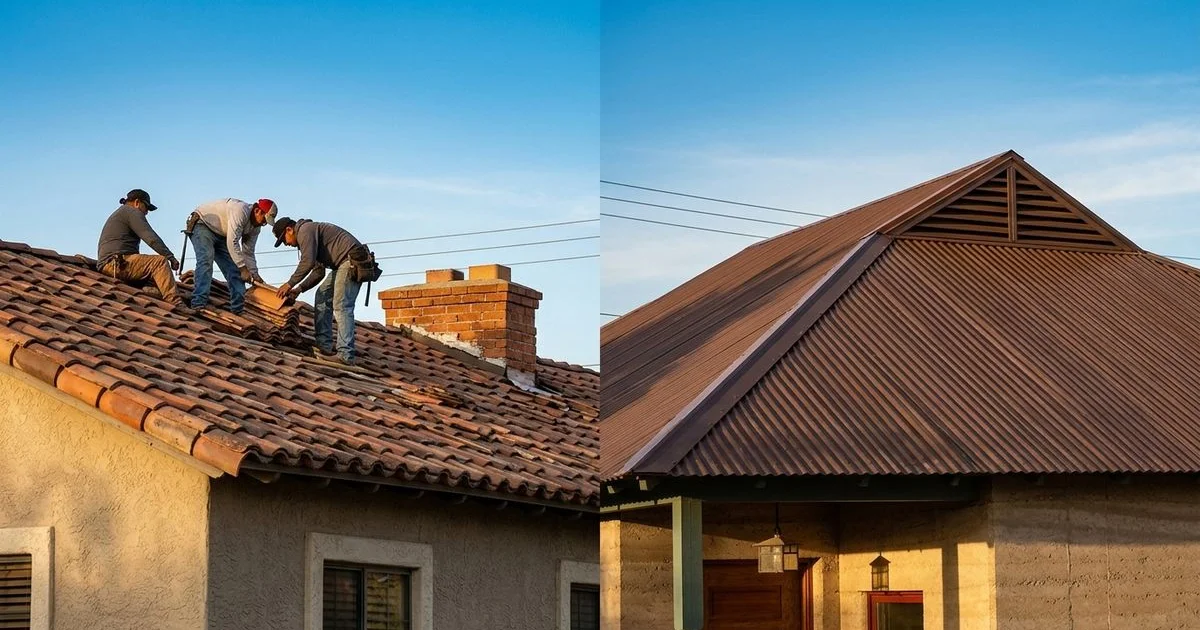
As a homeowner facing a failing roof, you likely recognize the immediate stress of leaks and cracked tiles.
We see this exact frustration every day across the desert.
If you are wondering about roof repair vs replacement: how to decide in Tucson, the answer requires looking past the initial price tag.
Let’s look at the data, what it actually tells us, and then explore a few practical ways to respond.
The Age Factor
Your roof’s age relative to its expected lifespan is the single most important factor in the repair-versus-replace decision.
We tell homeowners that age dictates the baseline for any structural investment.
”Recent 2026 data from Instant Roofer shows the average roof replacement in Tucson now costs around $23,938. That significant expense is why preserving a younger roof makes financial sense.”
We generally break a roof’s life cycle into three distinct phases:
- The First Half: Repair is almost always the right choice. Our teams frequently inspect 10-year-old tile roofs, 5-year-old metal roofs, or 8-year-old shingle roofs that have plenty of service life remaining. Addressing specific issues through targeted roof repair protects that remaining life without the cost of premature replacement.
- The Final Quarter: Replacement begins to make more financial sense. We compare continuing to repair a dying roof to putting new tires on a car with a failing transmission. You are investing in a system that will need a complete overhaul soon regardless.
- The Gray Zone: The middle 25 percent is where the decision gets nuanced. Our experts know a tile roof at age 30 out of a 50-year lifespan might warrant either option depending on its general condition and the state of the underlying components.
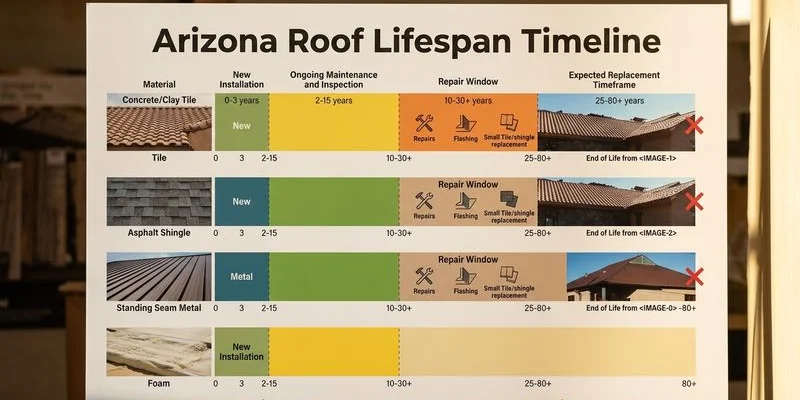
Here are the approximate lifespans for common Tucson roofing materials:
| Material | Expected Lifespan | Repair Zone | Replace Zone |
|---|---|---|---|
| Asphalt shingles | 15 - 20 years | 0 - 10 years | 12+ years |
| Concrete tile | 40 - 60 years | 0 - 30 years | 35+ years |
| Clay tile | 75 - 100+ years | 0 - 50 years | 60+ years |
| Metal (standing seam) | 40 - 70 years | 0 - 30 years | 40+ years |
| Flat roof (mod-bit) | 15 - 25 years | 0 - 12 years | 15+ years |
The Extent of Damage
The scope of the current damage is the second critical factor to evaluate.
We always look at the physical footprint of the deterioration before making a recommendation.
Localized damage (a leak around a single pipe boot, a section of cracked tiles from foot traffic, or storm damage to a limited area) is clearly repair territory. These are specific, identifiable problems with straightforward fixes that restore the roof to full function.
Widespread damage tells a very different story. Our inspections often reveal cracking across large areas, multiple unrelated leaks, extensive UV degradation, or pervasive underlayment failure. Repairing individual symptoms of system-wide deterioration is a losing proposition because new problems keep emerging from general wear and age.
”If more than 30 percent of the roof surface is affected by problems, a full replacement is likely more cost-effective than piecemeal repair.”
We find that if less than 10 percent is affected, repair is almost certainly the right call. Between 10 and 30 percent is judgment territory that requires professional assessment.
Many homeowners do not realize that local regulations influence this decision.
Our experience with Pima County and City of Tucson building codes is that replacing roofing materials with the exact same type does not require a permit, provided no structural decking work is involved.
This permit exemption makes straightforward “like-for-like” replacements slightly faster and more appealing if your damage is purely on the surface layer.
The Underlayment Question
This is the factor that many homeowners overlook, and it is particularly important in the desert heat.
We see underlayment failure as the hidden culprit behind most local roofing issues.
The material beneath your tiles, metal panels, or shingles has a much shorter lifespan than the roofing surface above it.
”When the underlayment bakes and cracks in the Arizona sun, your roof will leak even if the exterior tiles look perfect.”
Traditional felt paper underlayment (commonly used in Tucson homes built before the early 2000s) typically fails after 15 to 25 years.
The Shift to Modern Materials
Modern materials have shifted this timeline significantly.
We strongly recommend upgrading to SBS (Styrene-Butadiene-Styrene) modified underlayment, which is essentially rubberized asphalt.
Premium brands heavily used in Arizona, such as MBTechnology Layfast SBS or Polyglass TU MAX, offer extreme heat resistance and can easily last 25 to 30 years or more.
If your roof’s underlayment is deteriorated, the choices are clear:
- Underlayment replacement (re-roofing): Remove the existing roofing material, install new high-quality SBS underlayment, and reinstall the original tiles or panels.
- Full replacement: If both the roofing material and underlayment need attention, a complete replacement with new materials makes the most sense economically.
Underlayment replacement is very common with tile roofs where the heavy tiles remain in excellent condition but the felt paper beneath has expired.
We typically see costs for this process running $8,000 to $15,000, which is substantially less than buying all-new tiles.
The condition of your underlayment is something only a professional can assess properly, making a thorough roof inspection essential.
The Cost Comparison
Let me lay out realistic numbers for common scenarios on a typical 2,000-square-foot roof. We track material and labor pricing closely to give our clients accurate estimates.
By 2026, inflation and material availability have pushed average full replacements higher, making the math between fixing and replacing more critical than ever.
Here is a breakdown of what you can expect to spend for standard repairs versus full system replacements.
| Service Type | Specific Action | Estimated Cost Range |
|---|---|---|
| Common Repairs | Single pipe boot replacement | $150 - $300 |
| Common Repairs | Cracked tile replacement (5-10 tiles) | $300 - $800 |
| Common Repairs | Flashing repair around chimney | $400 - $1,000 |
| Common Repairs | Ridge mortar repair (partial) | $500 - $1,500 |
| Common Repairs | Section leak repair | $500 - $2,000 |
| Common Repairs | Underlayment patch (small area) | $800 - $2,500 |
| Full Replacements | Asphalt shingles installation | $8,000 - $15,000 |
| Full Replacements | Concrete tile installation | $16,000 - $28,000 |
| Full Replacements | Standing seam metal installation | $18,000 - $32,000 |
The temptation is to look at these numbers and always choose the patch job because it is cheaper today.
We caution homeowners to consider the cumulative financial drain.
If you spend $1,500 to $3,000 per year on recurring fixes for a roof that eventually needs a tear-off, three to five years of maintenance add up to $4,500 to $15,000. That is money that could have been applied to a new, secure system that comes with a fresh warranty and decades of problem-free service.
Climate-Specific Considerations for Tucson
Tucson’s climate adds several factors to the equation that do not apply in milder regions.
We adjust our recommendations based on how these harsh desert elements impact building materials.
UV Acceleration and Intense Heat
Every roofing material degrades faster here than the manufacturer’s national lifespan estimates suggest.
Our hot summers routinely push roof surface temperatures past 150 degrees.
Asphalt shingles rated for 30 years in Ohio might only last 15 to 20 years under the relentless Arizona sun. This accelerated baking process means the “replace zone” arrives much sooner than transplants from other states might expect.
Monsoon Risk and Sudden Damage
A roof in marginal condition can survive the dry winter months but fail spectacularly during a late summer storm.
We regularly respond to storm damage emergency calls after monsoon microbursts hit Pima County with 60 mph wind gusts.
If your system is questionable heading into July, the risk-reward calculation shifts heavily in favor of replacement. The cost of interior water damage and drywall repair from a monsoon-driven failure can easily exceed the cost of the structural replacement itself.
Energy Efficiency Opportunities
Choosing the right replacement material can drastically lower your summer utility bills.
We love showing clients how upgrading from dark, heat-absorbing shingles to a reflective cool metal roofing system provides massive energy savings.
According to recent data, a cool metal roof can drop attic temperatures by 20 to 35 degrees. This efficiency often qualifies for Tucson Electric Power (TEP) rebates and can reduce your annual cooling costs by $300 to $800, helping to offset the initial installation price over time.
Roof Repair vs Replacement: How to Decide in Tucson
Use this decision framework to evaluate your next steps.
We built these checklists to provide clarity when the choice feels heavy.
Choose repair when:
- Your roof is in the first half of its expected lifespan
- Damage is localized (affecting less than 10 percent of the surface)
- The underlying structure and underlayment are sound
- Annual maintenance costs are less than 2 percent of replacement cost
- You plan to sell the home within the next few years
Choose replacement when:
- Your roof has exceeded 75 percent of its expected lifespan
- Damage is widespread (covering more than 30 percent of the area)
- Underlayment has failed or is near its end of life
- Annual repair bills are escalating year over year
- You plan to stay in the home long-term
- You want to upgrade to a more durable or energy-efficient material
Get an Honest Assessment
Our team at Tucson Roof Gurus, led by owner Kevin Bayes, never pushes a massive project when a simple fix will serve you well.
A reliable contractor will refuse temporary band-aids when your home genuinely needs a completely new system.
Our roof repair inspections are thorough, honest, and completely free.
An expert will assess every component of your property and give you a clear, data-backed recommendation with the exact reasoning behind it.
When it is time to face the question of roof repair vs replacement: how to decide in Tucson, call (520) 775-0388 today to schedule your complimentary inspection.
Let our team help you make the right choice for your property and your budget.
Related Service
Learn more about our professional services related to this topic.
View Our Roof Repair Service →
Kevin Bayes
Owner & Licensed Roofing Contractor
Owner of Tucson Roof Gurus with 25+ years of desert roofing expertise.